
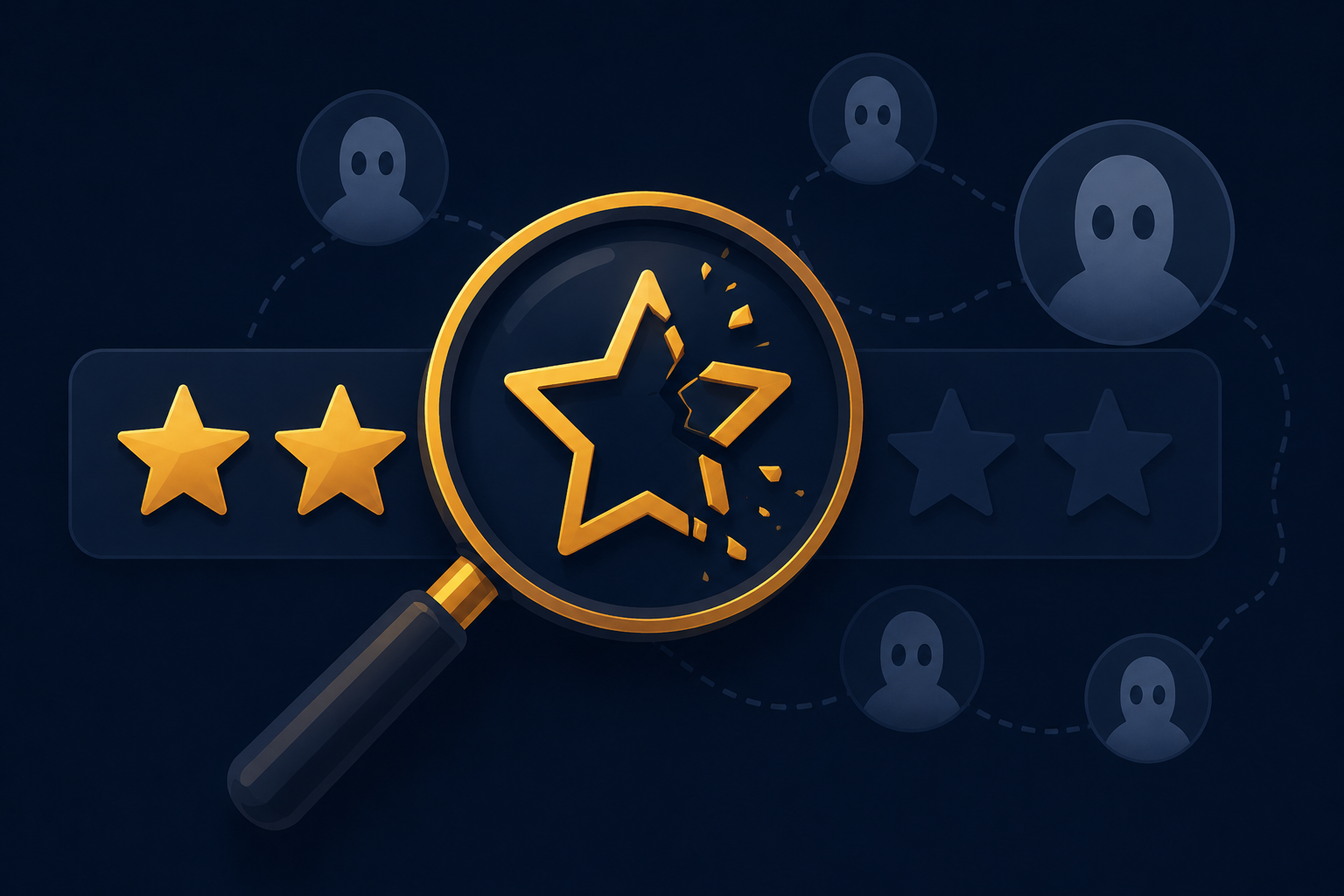
Fake reviews have become so common that spotting them is
practically a survival skill for anyone making decisions online. Whether you're
choosing a financial service, a contractor, or any business that handles your
money, knowing how to read between the lines of a review page can save you from
a very expensive mistake.
The good news is that fake reviews almost always leave
traces. Once you know what to look for, you'll start noticing them everywhere.
1. The reviews are suspiciously vague
Real reviews tend to be specific. People mention the name of
a staff member who helped them, describe a particular problem that got
resolved, or reference something unique about their experience. They have
texture.
Fake reviews are often generic to the point of being
meaningless: "Great service, highly recommend!" or "Five
stars, amazing company, will definitely use again." These could apply
to any business in any industry. That's usually because they were written by
someone who has never actually used the service and had nothing real to say.
2. A sudden spike in five-star ratings
Check whether a business received a flood of glowing reviews
over a short period - especially if there's a long gap with few or no reviews
before that. A legitimate business builds its reputation gradually. Twenty
five-star reviews posted within the same week is a pattern that warrants
serious scepticism.
Some review platforms show the date of each review, which
makes this easy to check. If they don't - that itself tells you something about
the platform's transparency.
3. Reviewers with no history
Click through to the reviewer's profile. Does the account
exist only to leave this one review? Was it created recently? Does it have no
photo, no other activity, no other reviews? That's a pattern consistent with a
fake account created for a single purpose.
Genuine reviewers typically have a history - other
businesses they've reviewed, a profile that's been active for more than a few
days.
4. The language sounds unnatural or translated
Many fake reviews are purchased through bulk services, some
of which operate internationally. The result is often reviews that sound
slightly off - unusual phrasing, overly formal language, or grammar that feels
like it's been run through a translation tool. If a review reads as though it
was written by someone for whom English is a distant second language, and the
business is targeting an English-speaking market, it's worth questioning.
5. All the positive reviews say the same thing
If multiple five-star reviews echo the same specific phrases
- "professional service," "transparent process," "exceeded
my expectations" - that's a sign they may have been written using a
template. Genuine customers describe their experiences differently, because
their experiences are genuinely different.
6. The one-star reviews tell a completely different story
Sometimes the most revealing thing about a business is the
gap between its glowing five-star reviews and its damning one-star reviews. If
the positives are effusive and vague while the negatives are detailed and
credible, that asymmetry is worth paying attention to.
Conversely, if the one-star reviews also feel suspicious -
identical grievances posted by accounts created on the same day, for example -
that may indicate a competitor attack campaign. More on that later.
7. The business responds defensively to negative reviews
How a business responds to criticism is often more telling
than the criticism itself. A company that responds to every negative review
with accusations, legal threats, or personal attacks is showing you something
important about how it operates. Legitimate businesses acknowledge problems and
try to resolve them.
8. The reviews only appear on one platform
Fake reviews are often purchased for a specific platform. If
a business has hundreds of glowing reviews on one site but very little presence
or a starkly different rating on others, that inconsistency is a signal.
Genuine customer satisfaction tends to show up across multiple places.
9. The review is suspiciously long and detailed - in a
promotional way
There's vague, and then there's the opposite problem:
reviews that read like marketing copy. If a reviewer seems to be describing the
business's services in enthusiastic detail - almost like they're selling it -
that can indicate the review was written by the business itself or by a paid
copywriter pretending to be a customer.
Real reviews have a human messiness to them. They mention
things that went slightly wrong even in an overall positive experience. They
have opinions, not just endorsements.
10. The platform doesn't verify its reviewers
This one isn't about the individual review - it's about the
platform hosting it. If a review site doesn't require any proof that a reviewer
has actually interacted with the business, then every review on that site
should be taken with a large pinch of salt. Verification is the most reliable
filter between genuine feedback and fabricated content.
Why spotting fake reviews matters more in some industries
For everyday purchases, a few fake reviews might lead you to
a slightly disappointing product. For financial services, investment platforms,
lenders, and other high-risk businesses, fake reviews can actively guide people
towards dangerous or fraudulent companies. The stakes are completely different.
That's why the standard for review platforms in those
sectors needs to be higher - not just "we try our best to remove
fakes" but "we verify every review before it goes live."
How RedAlertCheck handles this
At RedAlertCheck, we don't wait for users to report
suspicious reviews. Our AI-powered verification system screens every single
submission before it's published - checking for the kinds of patterns described
above and many more that aren't visible to the human eye.
The result is a platform where the reviews you read reflect
real experiences from real people. No vague five-star floods, no competitor
attack campaigns, no paid promotional content masquerading as customer
feedback.
If you're researching a business - particularly in a
high-risk industry - that's the kind of platform you should be using.
Related posts:
- Are
Review Sites Trustworthy?
- Can
Competitors Leave Fake Reviews on Your Business?
- Are
Fake Reviews Illegal in 2026?
Comments (0)